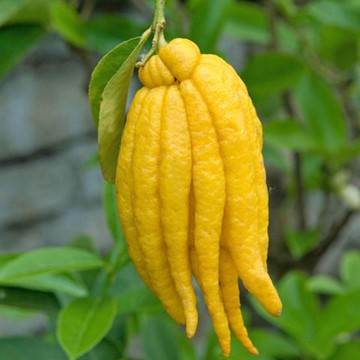
Buddha’s Hand – a sacred citrus fruit and delicacy
“Buddha’s Hand” (Citrus medica var. sarcodactylis) is highly regarded for its distinctive shape and cultural significance. In Buddhist tradition, as well as among an increasing number of chefs, it is considered a precious treasure—still relatively rare in our regions. To reveal the many uses of this sought-after citrus fruit, we invite you to explore its Asian origins.
Asian origin
As the name suggests, Buddha’s Hand originates from Asia and is widely found in countries around the Himalayan region. Its bright yellow fruit is divided into segments that resemble fingers, forming a hand-like shape that looks almost like a natural sculpture. In Asia, Buddha’s Hand is an important part of ceremonial offerings in Buddhist temples, where it is often presented as a sacred gift. The more closed and finger-like the shape, the more highly valued the fruit is, as it resembles a hand in prayer. It is also regarded as a symbol of happiness, contentment, and longevity.
Culinary uses
Although Buddha’s Hand is a relative of the common lemon, it is very different from the citrus fruits we usually know. It belongs to the citron family and contains very little pulp. As a result, it has low acidity and a milder, more aromatic flavor.
Its main culinary advantage is that the peel is edible raw and can be finely chopped or grated as an ingredient. It can also be shaved directly over finished dishes to add a fresh citrus aroma.
Rich meat dishes and delicate fish meals gain a unique flavor note from this citrus specialty. It is also widely used in cocktails and beverages, adding a refreshing citrus twist—especially in the popular “Gin Tonic”.
How to recognize a ripe fruit
A Buddha’s Hand is ripe when the tips of the segments show a slight brownish tint and small brownish spots appear on the peel. At this stage, the fruit develops a strong and intense aroma.
More interesting facts
Beyond its flavor, the fruit is known for its intense fragrance. The peel releases a sweet and pleasant scent and, when dried, is often used to freshen wardrobes and rooms naturally.
It is also traditionally believed to have beneficial properties: its peel contains essential oils that are said to soothe stomach discomfort and help lower high blood pressure.
About the plant
Citrus medica var. sarcodactylis has been cultivated for thousands of years as a useful plant in Asia. It is a heat-loving small tree that prefers a bright and sunny location.
Since it only tolerates brief drops in temperature down to around -5°C, it requires a frost-free, bright winter location with temperatures of about 10°C. From April onward, the plant enjoys being placed outdoors again, where it benefits from sunlight in the garden or on the balcony.
Flowering begins in spring, and ripe fruits can be harvested in December. Once mature, the fruits can remain on the tree for a long time, serving as an attractive ornamental feature.